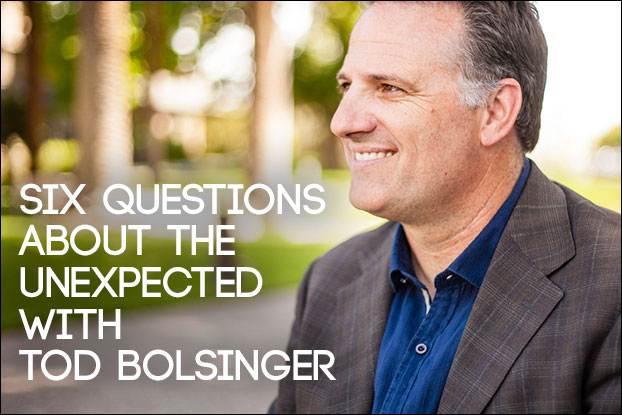
He's the Vice President for Vocation and Formation and Assistant Professor of Practical Theology at Fuller Theological Seminary, and Dr.
Tod Bolsinger is putting his theology to practical use as he releases his first book,
Canoeing the Mountains.
We get to know the author, speaker, consultation, blogger and former senior pastor by asking him six questions about his multiple callings, leading in the midst of the unexpected, and living in a post-Christian age.
How does being a professor make you a better author, and vice versa?
Being face to face in the classroom with the leaders and future leaders of the church gives urgency to my research and writing--and bringing the field experience of research, consulting, pastoring, and leading to the classroom gives relevance to my teaching.
You talk a lot about leading in the midst of the unexpected. How have you experienced that at Fuller as a professor?
Both as a professor and as an administrator, I live each day with the reality that the world is changing rapidly. The culture is changing, the Church is changing, higher education is changing, theological education is changing, and our students are changing all at the same time.
Our students are far more diverse theologically, culturally, and ecclesiologically today, and they are entering a world where the old "church pipeline" of seminary to pulpit is no longer even relevant. Half a generation ago, most students came to seminaries to be prepared for ministry in the church or the mission field. Today I am as likely to have an artist, a business leader, a lawyer, or a social worker in the classroom who is not looking for a traditional church "call," but discerning a call to Christian leadership in every sector of society.
Canoeing the Mountains is all about leading in unexpected situations. Do you see this applying across a broad spectrum of life, not just church leadership? For example, the music industry is in a major state of disarray and moving into the unexpected. Do you have any thoughts or advice about the state of music?
In many ways, the Church is now just finally facing what has been true in most other industries for over a decade. The music industry is one of the most well-known examples of a sector of society where innovation and technology have disrupted the old models of delivery (records, tapes, CDs, MP3), the economics (remember Tower Records? or even Napster?), and the artistry itself. Just last week, I supported a young artist on Kickstarter who is funding her first album with the request: "Do YOU want to be my label?"
Even as everything else changes around you, what's the most important thing to keep the same?
That's perhaps the most important question for leadership in "uncharted territory." Leadership scholar Jim Collins wrote, "Once you determine what should never change, then be prepared to change everything else." Every community, every church, every institution, every person must discern as clearly and concretely as possible: What are the essential beliefs, the core values, the central practices that are critical to my identity as a follower of Jesus in a changing world? What does it mean to be one who confesses "Jesus is Lord" with my lips and my life? What does that require of me to hold on to? And what do I believe holds on to me?
Your blog hints at the fact that we're living in a post-Christian age. While there are lots of reasons why this could be negative for believers, share with us a couple of reasons why it could be positive.
I prefer the word "post-Christendom"--conveying the reality that we no longer live in a world where we should expect the culture to support Christian faith or give preference to Christian faith over other beliefs or values. While coming to realize this is disorienting for those of us who just assume that America is or should be a "Christian nation," church history reminds us that Christianity often thrives when at the margins rather than in the seat of power and privilege.
In a post-Christendom age, we must learn to define ourselves by what we are for and not just what we are against; we must learn to demonstrate with our lives what others may not listen to from our lips; we must winsomely reveal the presence of God in every sphere of society in a world where most view matters of faith as deeply personalized and even private. When Christianity is at the margins, Christians find themselves in exactly the place where our Lord was in His society. And the words of Jesus take on more direct meaning, urgency, and relevance to us.
What's the biggest killer of innovation and adaptability as you see it?
What Ed Friedman referred to as "failure of nerve." That is, the tendency of leaders to cave under pressure and revert back to old ways of doing things when the anxiety of change gets too high in a community or organization. Friedman believed that organizational systems of all kinds are emotional fields where the overwhelming pressure is to protect the "peace" of the status quo through unintentional but completely normal sabotage of the very creativity and innovation we claim to desire.
For Friedman, sabotage is a normal, natural, to-be-expected response to the rising anxiety that comes amidst the uncertainty of change. Everything within us is wired to relieve anxiety and revert back to what is comfortable and known. Even the Israelites in the wilderness pined for the slavery of Egypt instead of facing the daily insecurity of the unknown. Once there is a clarity of discernment and commitment to enter uncharted territory, leaders must have the "nerve" to stay calm, stay connected to those who are most anxious, and then "stay the course" when the anxiety rises.