What if kindness really could change the world? For that simple hearted question to engage today’s complex society requires a bit of creativity. So when a duly imaginative group desired to write penetrating new music about loving well, a character was born.
“He’s like Buddy the Elf meets Forrest Gump,” says MercyMe singer Bart Millard of the fictitious namesake behind his band’s sixth studio album, The Generous Mr. Lovewell. “He sees the good in everyone and knows his neighbors enough to know their needs. Mr. Lovewell may not be the next Billy Graham, but he’s changing the world each day.”
The message of committing to extravagant selflessness and faithful optimism threads its way through every song, which is expressed with sounds created by a MercyMe eager to spread its musical wings.
NRT's Bill Lurwick took some time to speak with Millard about the album's multifaceted look at love, as well as the band cutting loose, musically speaking.
When I listened to The Generous Mr. Lovewell, I went out in the hallway here and I told everybody I just listened to the best project of the year. I'm serious.
Oh man. That’s awesome. The response we’ve gotten so far has been mind blowing. We were a little nervous. We kind of were at a crossroads ; we could keep making the same music because we’re sort of on top of our game right now, or we could take a risk. I don’t think many people take risks when they’re at the top of their game, so to speak.
So, that was the idea. Let’s do something that feels current and different. We loved it, we were just a little nervous, not knowing how everybody else is going to feel.

At this point in your careers, you guys could just mail it in, so to speak – but you’re not mailing it in.
Yeah. We still love music and we still love being stretched. I don’t want to write “I Can Only Imagine” again. We’ve already done that. Let’s do something that pushes us and brings just kind of a fresh perspective. It’s not reinventing the wheel, but for Mercy Me it’s a big step.
The song “Move” is a different sound, and the picture I got in my head was it's something the guys would do during sound check to have fun.
That’s exactly right. Well, that’s the kind of music we’d warm up with at the studio and then we'd settle down to do our power ballad. One of our producers asked us why we weren't writing the kind of songs that sounded like the amazing, jamming music we were making warming up. So we went down that road and just fell in love. Our slower songs on the album are very recognizable because we do still love that kind of music, but out upbeat music of the past has had kind of lost its identity. We just love pop music and it was just a blast to get permission to do it; getting cut loose was so great.
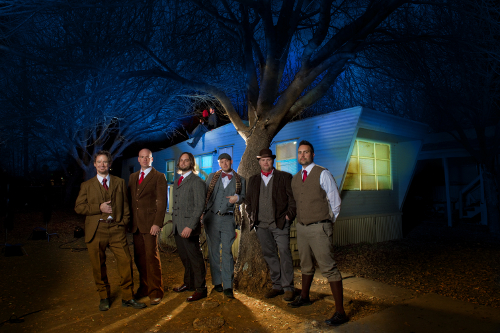
Now, tell us about the namesake of the new album, Mr. Lovewell.
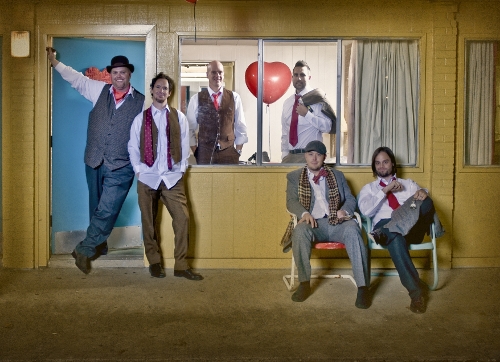
We try to keep the mystery about Mr. Lovewell. He’s just this quirky idea and it’s a different way to get a message 2,000 years old across to people about loving your neighbor and loving your enemy and so on. The first thing we tried to do is to draw enough attention for people to listen to us. I think Mr. Lovewell has kind of done that; it’s just odd enough, this grown man wearing a Mister Peanut suit and carrying a heart shaped balloon where people are intrigued by it and we have clans of people actually making appearances like at a football game and stuff where they may show up on TV and stuff as Mr. Lovewell.
There are just a lot of little things to keep the character going to where people are intrigued by it. Hopefully through that they seek it out and realize the message is basically pay it forward, which really revolves around the cross. If you’re going to spend marketing dollars, why not spend them in a way that it hopefully makes the world a little bit better place? This seemed a lot more fun and a lot more effective than just trying to put ads in a magazine or whatever.
You guys talk about and you said we can love well all we want, but if we do without Jesus, it doesn’t really mean anything.
Right. Which is the last song on the album, “This So-Called Love,” talks about that. It’s one thing to pay it forward or to be kind and treat people better, which society will say is good enough, but man, if you’re not sharing the Gospel with them, which we believe is the absolute answer to everything, then it’s almost offensive.
People should be one day saying, “Why didn’t you tell me everything and not just get the door for me or tip me as a waitress or whatever? Why did you not tell me this?” The Bible talks about that. When you’ve done it to the least of these, you’ve done it to me and they’re going Lord, when were you sick? When were you hungry? I think that you can’t fall short on this. If that’s what we truly believe is that the absolute answer is Christ, then that should be one of the first things that’s coming out.
How has the Lovewell concept materialized in your own life? What are some of the changes the Millard family made or how did that affect you personally?
For us, my family has been a ministry to me. My wife has done an amazing job of working with our four kids and showing them what it means to be the hands and feet of Christ to so many people. We’ve done it for years, especially around Christmastime in different ways. Just the other day I was doing an interview about Lovewell and things that we’ve seen and been able to do on the road. My son was sitting next to me, watching me do the interview, and I realized maybe we weren't doing enough here, at home. So we have an elderly neighbor that can’t get around that well and we went over and landscaped her yard, got her yard ready for spring, all that kind of stuff, and my kids were full on into it.
So, it really is just trying to do the little things that may not mean that much to us, but mean the world to everybody else.
Talk about “All of Creation.” It’s number one, no surprise there. Straight up worship song, isn’t it?
Yeah. The idea for the record was there’s three parts of love on the record. One is Lovewell, that we should reach out and love everyone and just give them a chance. The other is basically understanding that there are some people that feel like they’re not worth being loved because they’ve done things so horrific that God could never care about them and the idea was to get it across that you will never be out of the reach of Christ and that you are loved.
So, it’s more self-esteem kind of thing, so to speak and then the other is our source of love is Christ. So, there are worship songs like “All of Creation” and “Only You Remain.” It’s not us singing an “I love you Lord” kind of worship song. It’s saying that we love because Christ first loved us. That’s what we’re trying to get across in the worship songs on the record.
Appreciate you, Bart, for spending time with us at NewReleaseTuesday.
My pleasure. Thanks for having me.