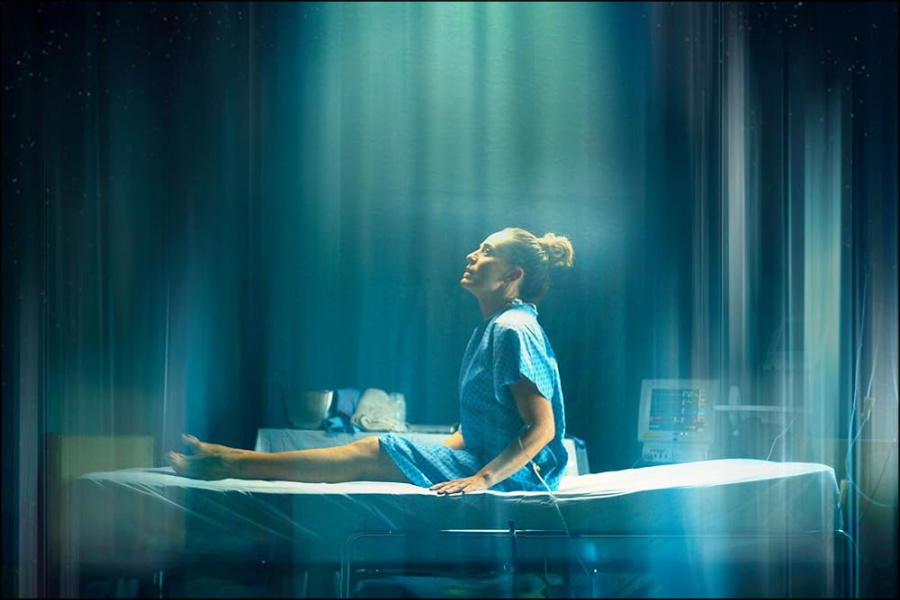
When you write an incredible, generation-defining, genre-defying book like Donald Miller's
Blue Like Jazz, how in the world do you expect to translate such an experience to film?
Well, you don't, exactly. Miller's bestselling "nonreligious thoughts on Christian spirituality" were put into narrative form, in order to tell an external story that captured the internal musings Blue Like Jazz explored.
I watched
Blue Like Jazz: The Movie on opening night, although it was more out of production curiosity than it was for the content of the film per se. I had seen the rough, yet VERY FIRST screening of the film at Miller's Storyline Conference—which, Director
Steve Taylor readily admitted, was rife with gaping post-production holes.
When I sat down in my seat at a theater in the town in which the movie is set, I didn't expect many surprises from my first screening. But I got them.
The movie is one of those generational, coming-of-age films, where a wide-eyed, innocent protagonist slams into the cold, hard, real world and has to recalibrate. Don's character (played by Marshall Allman) leaves the Christian bubble of his native Texas in order to escape trouble at home and start a new life in the anything-goes climate of the very real Reed College in Portland, Ore.
He dabbles—and then dives headfirst—into the hedonistic and decidedly anti-Christian environment at Reed. It's his first real rebellion, fueled by the embarrassing sins of his mother, and the blatant, glib hypocrisy of his former youth pastor.
In
A Million Miles in a Thousand Years—Miller's book about story, which features his converting
Blue Like Jazz into a fictitious screenplay--Miller says every story requires that a character wants something and has to overcome conflict to get it. At face value, some might suspect that
Blue Like Jazz: The Movie is about Don overcoming doubt to find faith on his own. They'll say that it doesn't neatly explain the Gospel message and it contains language that isn't child-friendly. But I think if you stop there, you miss out on a lot that this film offeres. I think it goes deeper, and is more profound, than that.
Just after opening weekend, I chatted with
Steve Taylor about my theory of a double-meaning within the film, "weird" Portland culture, and the film's connection to Taylor's 1980s solo albums.
First of all, congratulations on the movie, it's awesome. I just saw it, although I had seen it at Donald Miller's Storyline Conference in Portland last summer.
The longest night of my life!
It was awesome, and so I went to see it a few days ago expecting no surprises, really. You know, I'd seen it before and wanted to see what the final product looked like. But I got lots of surprises! There were some scene additions, and then I picked up on this just kind of awesome story within a story kind of thing. It was just a great experience. How are you all feeling about it?
Thanks. We're really happy with it. Hopefully something you noticed was that when the actors' lips move, the sound comes out of it at the same time. [
Note: He was referring to some audio issues experienced at the first-ever screening of the film at Storyline last summer.]
So now that we're past opening weekend(s), how's the whole team feeling?
We're feeling really good about what's happening inside cities, but when it came to the suburban areas and exurbs, we did not do well. I think in hindsight, we probably would've booked a lot more of the city center and art house theaters, because we really did well there. And we probably would've booked a whole lot less of the suburban theaters; they dragged down our per-screen average.
One of the last screenings we did was in Pasadena, and [one guy from] our distributor, Roadside Attractions, was there and they said, "Wow, Steve. The audience here is really different from what we expected." I said, "What did you expect?" And he said he was surprised that the people there were "just like the audience for our other movies."
I think he thought this was going to play like
Courageous or something like that, because that's really the only evidence out there for Christian-oriented films. I think our distributor was having a hard time getting their head around the fact that this was for a different audience—the kind that probably doesn't go to typical Christian movies, but they go to see movies every weekend.
After watching the film the second time, it seems to me that the intended audience really is the Christian or ex-Christian who is sort of disenfranchised with the Church, or struggling with the Church. Is that safe to say?
I think that's part of the audience. The book was read by a lot of Christians who were disenfranchised with how they were all being lumped together. And people outside the Church assumed we all shared the same checklist of beliefs—that you must believe this and this and this—some of which has absolutely nothing to do with Christianity, where we end up with this kind of Americanized Christianity that frankly is more American than Christian sometimes.
Blue Like Jazz the book helped a lot of us go, "Oh, wow. I'm not alone," and a community galvanized around that notion. In the same way, the movie is hoping to do the same thing for people who don't like to read.
What are some of the comments you're beginning to hear from the fans? Are you beginning to see a pattern from the response?
Yes. We did a lot of screenings throughout the fall and early spring--first of all to see how fans of the book would respond, and their responses were overwhelmingly positive. You don't put
Blue Like Jazz out and think, "Oh, I see this movie in my head." They're more curious as to see HOW they put this book into a movie, as opposed to thinking, "Oh, man, I hope they don't mess up this story," like you'd think if you were seeing Lord of the Rings or something like that.
The single-word response we keep getting from a lot of people is "finally." There's finally a movie from a Christian perspective that doesn't try to tie everything up. A movie that doesn't show that we become a Christian and God solves all our problems. It portrays the very real struggles all of us have--between faith and doubt, between being part of a church and working or going to school in an environment that doesn't necessarily share or respect our beliefs. It portrays this tension that I think most of us feel being a Christian, living in this world.
One review I enjoyed reading stated, "It strangely belongs in the same universe as Portlandia." I live in Portland, and so I enjoyed all of the local references. There was such a great homage to our town, really. It wasn't fictionalized; it was very real.
Fred Armisen [of Portlandia] is a friend of mine, and we were working on
Blue Like Jazz around the same time they were shooting
Portlandia, so we shared a lot of the same crew. That show is hilarious. The great thing about it is that people who see it and aren't familiar with Portland or Reed College assume it's a caricature, but it's not
that much of a caricature.
Yeah, it's pretty close to the real deal. I'm sure there are people across the country, or even in those suburban areas who say, "Oh my goodness; I can't believe they wrote in these strange things that happened." No, this is really how it is here in Portland.
Don [Miller] told me that a few months ago he saw, in Portland, a guy in a Darth Vader mask wearing a kilt, riding a unicycle while playing the bagpipes. I thought that was a pretty great Portland image.
About 3/4 of the way through the movie, it clicked for me that there was a sort of parallel story going on. In the scene where Penny is trying to get Don to reconcile with his mother, Don adamantly refusing, exclaiming, "She's a slut!" to which Penny responds, "She's your mother!" And in my mind, something clicked because I thought of the Saint Augustine quote, "The Church is a whore, but she's my mother." I thought back through the movie and realized that he's wresting with his relationship with his mom just as much as he is with Church and Christianity. Was that intended?
It's intended now! That's one of the coolest things I've ever heard about the movie. Yeah man, I'm going with that. Let's just say I knew the quote, and it was meant to be in there. That's really good, very impressive.
It was like his mother is trying to get in touch with him and reconcile with him the whole time, and he's not paying attention. And at the end of the film, Don says, "God has been following me the whole time." So yeah, whether intended or not, there's this great double story of how the church and his mother are embarrassing and infuriating, but in the end it's his family. He comes to the conclusion of, "Well, where can I go? I'm related."
Yes, very well put.
If you miss Don's pursuit of trying to figure out church and God and coming to terms with his embarrassing family, you'll just see this film as a story of someone who goes to college, parties and then says, "I think I need Jesus." And that's now what this story is about, you know.
Yeah, we needed him to have the full experience. He needed the parallels of rejecting his church and then, when he comes to a deeper faith, stepping back inside its walls—tentatively, for sure. I think my favorite shot is when he dips his fingers in the holy water in the Anglican church, and his fingers are sort of floating around, like a little kid wading in the pool.
Now, obviously Blue Like Jazz the book is Don's memoir, and the film is based on that to some degree. But obviously you had to put yourself into the film somehow. What scenes or pictures resonate with you most? What are some Steve Taylor moments in this movie?
Funnily enough, I'm actually on my way to the airport to come home from a screening at Colorado University in Boulder, which is where I went to college. I grew up in a Baptist church, and my dad's a Baptist minister. I was actually a youth pastor at our church while I was going to Colorado University in Boulder. One of the reasons I wanted to make this movie was because I really felt like I've lived it. And I remember that sense of feeling lost, or coming into this huge campus at a state university.
It was a great experience screening it there. While the movie was showing, I'd introduced it and then I just went for a long walk around campus. I just remembered the questions—How do I fit in here? Do I belong here?—and having all my beliefs challenged, and the necessity of making my beliefs my own, instead of having them passed to me by my church and my parents. So it brought up a whole range of emotions being back there last night, and it was a great experience.
Looking through your discography back when you were a solo musician, it seems that Blue Like Jazz is a pretty good continuation of the message you got out in your music. Would you agree with that?
Yeah, it definitely felt that way to me as well. The first movie I did—
The Second Chance—I'm still really happy with, it just was a more conventional story. People who were fans of what I'd done probably were a little surprised, and maybe a little disappointed that I hadn't tackled something that was closer to what I'd done as a recording artist. This is more reflective of my overall sensibilities, I guess.
So really, the sort of mission or focus with you has been taking the conventional things many Christian don't think twice about, and saying, "Are you sure that's like Jesus?"
Absolutely. With my song, "I Want to be a Clone," the whole theme of it was … assembly-line Christianity, that if you decide to follow Jesus, you get a whole checklist of things you are to check-off as well.
So what has God shown you and done in you throughout this process of making this movie—a process that started in, what, 2007?
Yeah, man, it was six years. I don't recommend working on anything for six years. For one, it showed me how easily I can turn something good into an idol. There was a book that Tim Keller wrote called
Counterfeit Gods, and in many ways it was the book that got me through this whole ordeal. Because I could not imagine life without getting
Blue Like Jazz made, it was like an obsession. And I feel like Go allowed me to make it, in His mercy. I had to get to the place of giving things up to God and trusting Him whether the movie gets made or not. And you know, just knowing His will is going to be accomplished.
I've felt and experienced God's providence so many times in the making of this movie—through times when we were out of resources and out of hope. And in the way it brought our team together, particularly Don and Ben Pearson—our co-writer—and Marshall [Allman], our lead actors. I said a prayer this morning thanking God He made all this possible. It's a long list.
What's the most difficult thing for you now that the film is out there to the masses?
It's out there! There's still so much work; it's quite exhausting. So the hardest part is just staying awake.
What's next for Steve Taylor?
Don, Ben Pearson and I have an idea that Ben came up with that we think is a really good idea, and we'll get to work on a new screenplay. We'll take a little break, and then we'll see what comes of it.
Well I appreciate it so much, Steve. Thank you for the film. It's really important. Blessings to you.
Thank you. I really enjoyed the interview.