Is radio dead?
It’s a question that has been lingering for some time now. Streaming has become the dominant method for many of us to listen to music, podcasts, and talk radio, and we have a variety of devices and options available. When the news broke that EMF (KLOVE, Air1) acquired several radio stations from Salem Media Group, the question came back to my mind.
There are few nationwide networks in Christian music—stations that rebroadcast their signal across multiple cities without a local presence. Each passing day seems to bring a decline in local stations. One of Salem's stations sold to EMF is KLTY, the local station in the Dallas/Ft. Worth area where I live. This means that some sound familiar to my friends and family here will likely be replaced by a KLOVE station. During a conversation with my worship team in the green room, I noticed that most of us have memories of the station but aren’t active listeners. After reflecting on it, I can’t recall the last time I saw the KLTY street team at an event or concert.
The mood among Christian music fans in that room is that radio is either dead or dying. Even on short drives, phones are plugged in or connected via Bluetooth. Sometimes, I feel like I’m in the minority when I listen to the radio while driving around town. I enjoy listening to the DJs, and my kids and I often play “name that artist” as songs play. It could also be that I’m too lazy to plug my phone in for a 15-minute drive, but I prefer the “I love radio” version more. Regardless, I appreciate hearing Christian music on the airwaves.
In this context, radio remains relevant and holds a promising future. Does it encounter challenges that need to be addressed? Indeed, but I believe these are not insurmountable.
The main critique of radio is that songs are repeated too often, and the selection criteria make everything sound the same. There is some validity to this, although I have nothing but love for my friends in the national networks. I miss the old days of Air1 when I could listen for hours, and repeats were the exception, not the norm. Air1 also introduced me to bands like Stellar Kart, Decyfer Down, Fireflight, Kutless, and Hawk Nelson—I could go on. I know there are studies, metrics, cycles, and various factors behind the scenes that I don’t fully understand, but I long for that experience as a listener.
The next point about radio is the advertisements and pledge drives. I understand that bills must be paid; it takes more than good intentions. The key is to find a balance. I noticed that over half of the programming on KLTY recently consisted of ads. Not only that, but the quality of the advertisements seemed questionable to me: Jesus one minute, laser hair removal the next.
The final point I want to address is comparing large national networks and local stations. My church often emphasizes that while Sunday morning services are fantastic, the true strength lies in the small groups that meet during the week. The same can be said for local radio stations. With their strong presence in the community and the ability to tailor programming for their specific regions, local radio stations are champions of Christian music (and a shout-out to our friends at Project 88.7). It’s simply not feasible for a national station to engage in every market it serves.
That said, I love KLOVE, WayFM, and all Christian radio. I may not listen daily, but I know God is at work. I appreciate that Christian music is available on the airwaves for people to discover, whether deliberately or by chance. Even with song repeats, I still find new music on the radio.
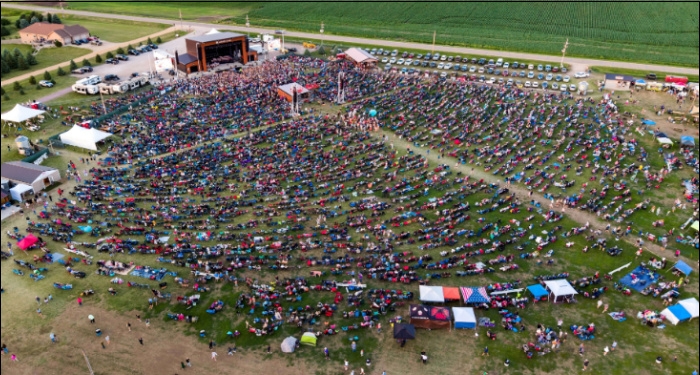
One way these stations are adapting is by creating programming for the digital realm. Whether it's podcasts, video series, or playlists, their reach goes beyond their signals. They also host local events, both large and small (KLOVE Live at Red Rocks, anyone?), made possible by the scale that national networks offer.
I believe that radio is anything but dead. I would love to see changes and more local stations, but I’m not ready to count this format out yet. There are many stories of how discovering a song on the radio impacts people; even Christian contemporary artist Zach Williams is a product of radio playing the right music at the right time. Radio is, however, going through a transition period and rediscovering its identity in this digital world.
The most significant gap I see is in identifying the champions of Christian music within our communities. While the local signals acquired by EMF will continue to broadcast Christian music, many jobs have been lost, and a significant percentage of these positions directly relate to promoting Christian music. I recognize that, like other small businesses, maintaining a local radio station is challenging, which likely contributed to EMF's acquisitions and the complete shutdown of some stations. I don’t have all the answers, but this issue must be on the list of matters to address as radio navigates its new identity.
I don’t know where else to include this, so I’ll conclude with this: I genuinely believe there is immense value in the human connections that DJs bring to the table. Sometimes, it’s a bad joke that lightens the day's heaviness. Other times, it’s a story that reminds you that you’re not alone in your struggles. Occasionally, it’s just a quick devotion to help refocus your heart and soul. I love listening to The Wally Show during my morning commute before I plug in my phone because one of those things typically kicks off my day. Mostly the bad jokes, but I’m all for it.
Jake is the host of the NRT Now Podcast. He lives in Dallas, TX, with his wife and three kids.
|