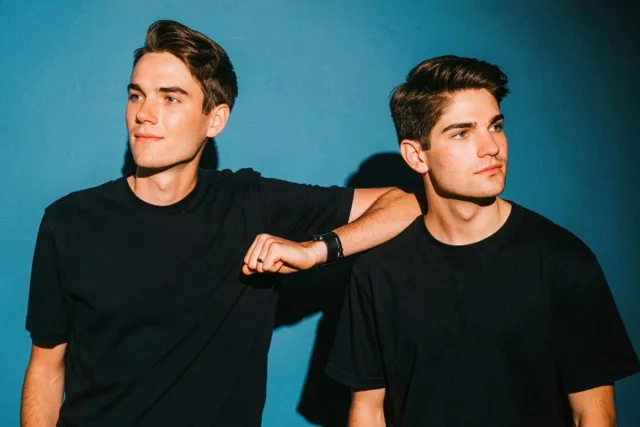




Touring over 100 dates a year and performing more than 700 shows will teach you a thing or two about what really matters. For the brotherhood duo The Scally Brothers, it’s not about flawless stage production or chasing vanity metrics—it’s about being real, offering hope, and pointing people directly to Jesus. Drawing dynamic pop-rock inspiration from acts like for KING & COUNTRY, Phil Wickham, and Matthew West, brothers Zach and Jake Scally have built a ministry that balances high-energy live shows with deeply vulnerable storytelling. That heart shines through their breakout radio hit "Keep Hopin'" and their latest single, "When I Walk (Psalm 23)," a track born from a terrifying near-miss on the road that turned a mechanical crisis into a powerful testimony of God's protection.
Behind the music, the brothers credit their complementary strengths—Zach handling the grueling travel logistics and Jake crafting the visual world—and a shared foundation in their Catholic faith for keeping their ministry grounded and broadly uniting. Fresh off teasing a brand-new album packed with creative risks and reflective worship moments, and ahead of the upcoming Hallelujah Tour, Zach and Jake sat down with us to discuss their journey from playing at local churches, the miracle behind "When I Walk," and why they're keeping their eyes fixed on serving others through every open door.
For readers discovering The Scally Brothers for the first time, how did you begin making music together, and when did you sense it becoming a ministry?
We’ve been making music together for most of our lives, but The Scally Brothers really began to take shape when we started playing music at our church and in our local community. What started as two brothers who loved writing and performing songs slowly turned into something much bigger than we ever could have planned.
At first, we were simply excited to make music together. But as we began traveling, playing more shows, and hearing people say a song encouraged them, helped them through a difficult season, or brought them closer to God, we realized these songs could be more than music. They could reach people.
There was a moment when we realized, “This isn't just what we do—this is why we do it.” We’ve now had the opportunity to perform hundreds of shows in schools, churches, festivals, and communities all over the country, and we’ve seen firsthand how powerful music can be when it points people toward hope. The ministry has grown far beyond what we imagined when we started, but at its heart, we’re still just two brothers trying to use the gifts God gave us to encourage people and remind them that He is with them.
What musical and spiritual influences helped shape your Christian pop sound?
One of our biggest musical influences has been the popular Christian band for KING & COUNTRY. We’ve always loved the way they combine huge, energetic production with deeply meaningful, faith-filled lyrics. There’s something about their music that feels both incredibly polished and incredibly human, and that’s something we’ve always wanted to capture in our own music—songs that can fill a room with energy but still have a message that sticks with you long after the song is over.
We’ve also been influenced by artists like Phil Wickham, Brandon Lake, Chris Tomlin, and Matthew West, each for different reasons. Phil and Brandon have influenced how we think about worship and how we create moments where people can genuinely encounter God through music. Chris Tomlin has been such an incredible example of writing songs that are simple, memorable, and deeply rooted in Scripture—songs that people can carry with them for years. And Matthew West has always been a great example of telling real, relatable stories through music and connecting faith to everyday life.
Ultimately, though, our greatest spiritual influence is Scripture and the people we meet through ministry. So much of what we write comes from things God is teaching us personally, passages of Scripture that have challenged or encouraged us, and stories we hear from people at our shows. We want our music to be honest about real life while still pointing people toward the hope we have in Christ.
We love the fact that Christian music can sound so many ways, and we’re constantly learning from the artists around us. Our goal is to take those influences, combine them with our own story and personality as brothers, and create music that makes people want to sing, feel something, and, most importantly, remember who God is.
How do your different personalities and creative strengths complement each other as brothers and bandmates?
We’re different in a lot of ways, and honestly, that’s probably one of the biggest reasons The Scally Brothers works. We’ve naturally fallen into different roles that fit our personalities and strengths well.
Zach is more of the operations and logistics guy. He handles a huge amount of what happens behind the scenes—booking shows, coordinating with our band members and crew, arranging hotels, managing travel, and making sure everyone knows where they’re supposed to be and when they’re supposed to be there. When we’re traveling over 100 dates a year, there are a lot of moving pieces, and Zach makes sure they all come together.
Jake tends to live more on the creative side. He’s more heavily involved in the live production—things like our lighting, video content, and how the show looks and feels. He also runs our social media and spends a lot of time creating the visual world around the band, from album artwork and music videos to tour graphics and merch. If there’s a blank screen, a blank canvas, or a new creative idea, Jake is usually excited to jump into it.
Even though those roles are different, they really complement each other. Because we’re brothers, we can be honest with each other. We can challenge an idea, disagree, laugh about it, and keep moving. At the end of the day, we both have the same goal: to make The Scally Brothers the best band and ministry it can be. We may approach that goal from completely different directions, but having both sides of that equation has been a huge gift.
“Keep Hopin’” has reached millions of listeners and nearly 100 radio stations. How did its success affect your music and ministry?
“Keep Hopin’” was one of those songs where we knew we believed in the message, but we never could have predicted how far God would take it. Seeing it reach millions of listeners and make its way onto nearly 100 radio stations has been incredibly humbling.
What has meant even more to us, though, are the stories behind those numbers. We’ve heard from people who played the song during incredibly difficult seasons, families who made it part of their daily routine, and people who told us the song reminded them not to give up. Those stories have reinforced why we write in the first place.
Its success has also given us a bigger platform, but we don’t want to lose sight of what that platform is for. If more people are listening, we want to use that opportunity to point more people toward hope, faith, and ultimately toward God. “Keep Hopin’” reminded us that a simple message can travel much farther than you ever imagine when God gets a hold of it.
What inspired your latest song, “When I Walk (Psalm 23),” and why did you also record a banjo version?
One of the most rewarding parts of being artists is taking something that happens in our own lives and turning it into something that can remind somebody else that God is with them. “When I Walk (Psalm 23)” came directly out of an experience we had earlier this year that reminded us of God's protection and faithfulness in a very real way.
We were driving from Ohio to Iowa for a huge youth conference, where thousands of students from across the state were gathering to worship Jesus.
Before every trip, we take our vehicle into the shop—we change the oil, rotate the tires, have everything inspected—because when you live on the road, you want to know you're safe.
But somewhere during that seven- or eight-hour drive, we started hearing a strange rumbling sound. As we got closer to Iowa, it got worse. The steering wheel shook, the entire vehicle vibrated, and we knew something wasn't right.
When we finally pulled over and looked at the front tire, three of the lug nuts were completely gone. The other two were so loose that we could tighten them with our fingers. A technician came out, looked at the wheel, and told us, “You guys are lucky to be alive. That tire should have fallen off a long time ago.”
That moment really stopped us. We realized that God had been watching over us the entire drive. We had traveled hundreds of miles without realizing how serious the situation was, and somehow He had protected us.
And that wasn't even the end of the difficulties that weekend. After we arrived and unloaded all our equipment, speakers started failing, tracks stopped working, and one technical issue after another kept coming up. It felt like everything that could go wrong did.
But in the middle of all of it, we kept coming back to Psalm 23: “Though I walk through the valley of the shadow of death, I will fear no evil, for you are with me.”
That became the heart behind “When I Walk.” We realized that Psalm 23 wasn't just a beautiful passage of Scripture—it was something we had just experienced. God doesn't promise that we'll never walk through valleys. He promises that He will be with us when we do.
And then we saw why the enemy couldn't have the final word. Despite everything that went wrong that weekend, more than 500 students responded to the Gospel.
People encountered Jesus.
Lives were changed.
We could have looked back at that weekend and remembered it as the weekend our tire almost fell off and everything went wrong. Instead, we look back and see God's faithfulness.
That's what we wanted “When I Walk” to communicate. When we sing it now, we're not just singing words from Psalm 23—we're singing something we've experienced firsthand: even when you're walking through a valley, you are not walking alone.
We also wanted to record a banjo version because we love showing different sides of our musical selves. The original version carries the weight and emotion of the story, while the banjo version brings a little more of our personality and roots into it. It has a calmer, joyful energy, which we love because there's something powerful about taking a song about walking through a valley and giving it a sound that feels full of life.
Ultimately, if someone hears “When I Walk (Psalm 23)” while they're going through their own valley and it reminds them that Jesus is still with them, that's the greatest reward we could ask for as artists.
You recently teased that a new album is in progress. What can you share about its sound, themes, and expected release?
We are incredibly excited about this next chapter. We’re working on a new album right now, and it feels like a natural evolution of The Scally Brothers while still sounding unmistakably like us.
The album will have a lot of energy, but it also includes some vulnerable, reflective moments. At its center are themes of hope, trust, identity, perseverance, and what it looks like to follow God through every season—not just the easy ones. Some songs feel like they belong at a live show with thousands of people singing together, while others are much more intimate and personal.
We’re also giving ourselves more freedom creatively. We're exploring sounds and arrangements on this project that we haven't before, and we're really enjoying figuring out what this next version of The Scally Brothers sounds like.
We’re not ready to give away every detail just yet, but the album is coming together, and we can’t wait for people to hear it. More will be revealed soon.
How will the new music build upon—or differ from—KEEP HOPIN’ // KEEP DREAMIN’?
KEEP HOPIN’ // KEEP DREAMIN’ really established a lot of the heart and message we wanted The Scally Brothers to be known for. It was about choosing hope, continuing to dream, and believing that God is still working even when you can't see the whole picture.
The new music builds on those same themes, but I think there’s a little more depth to it. We’ve lived more life since KEEP HOPIN’ // KEEP DREAMIN’. We’ve traveled to more places, met more people, walked through different seasons, and experienced both incredible highs and difficult moments. Naturally, those experiences have found their way into the songs.
So, while the new album will still have those big, joyful, hope-filled Scally Brothers moments, it also includes songs that wrestle with questions, surrender, trust, and what it means to keep following God when things don't go according to plan.
After performing more than 700 shows, what have you learned about connecting with audiences, and what makes the Hallelujah Tour distinctive?
After more than 700 shows, one of the biggest things we've learned is that people don't necessarily need you to be perfect—they need you to be real. The best moments on stage aren't always the moments when everything goes exactly according to plan. Sometimes it's when we share a story, make a joke, invite the crowd into a song, or create a moment where people realize they're part of something bigger than themselves.
Every audience is different, but people everywhere are looking for the same basic things: hope, connection, joy, and a reminder that they aren't alone.
That's a huge part of what makes The Hallelujah Tour special. We don't want it to simply be a concert where people watch two brothers perform songs. We want it to feel like a celebration. There are moments to jump and sing, moments to laugh, moments to worship, and moments to simply be still and remember what God has done.
We want people to leave with more than a good memory. We want them to leave encouraged, with renewed hope and a desire to live their faith more boldly.
How does your Catholic faith influence your songwriting while allowing your music to connect with the wider Christian community?
Our Catholic faith is at the foundation of who we are, and it naturally shapes how we see the world, write, and approach ministry. Our faith isn't something we separate from the music—it’s the reason we're making the music in the first place.
At the same time, we’ve always wanted our songs to focus on what unites Christians: Jesus, Scripture, hope, grace, worship, trust, and God's incredible love. We’ve had the privilege of ministering to people from many different Christian backgrounds, and we love seeing how a song can bring people together.
We don't believe music has to erase what makes our traditions unique. Instead, it can remind us of the much bigger things we have in common. Whether we're singing in a Catholic church, a Christian school, a festival, or somewhere completely unexpected, we pray people encounter the same message: God is good, He is present, and there is always reason to hope.
How can we be praying for you?
Pray that we never lose sight of why we started.
It’s easy, especially as things grow, to get caught up in numbers, streams, radio stations, social media, travel, and everything that comes with being a full-time band. We’re grateful for every opportunity God gives us, but we want the ministry to always be bigger than the music.
Pray for the people we’ll meet on the road—for the person who desperately needs hope, the student who feels alone, the family going through something difficult, or the person who may be encountering God through a song for the very first time.
And pray for us as brothers. We spend a lot of time together, on the road and off the road! We want to continue growing not only as musicians, but as brothers, as men of faith, and as servants.
Ultimately, we want to be faithful with whatever God puts in front of us. If He gives us a big platform, we want to use it well. If He asks us to sing to a room of five people, we want to give those five people everything we have. Our prayer is simply that God would use The Scally Brothers however He wants—and that when people encounter us, they would encounter something that points them back to Him.